

Engineering takeaways
- A press recipe records setpoints; process history records what the material actually experienced.
- Moisture moves and redistributes during pressing, so one average value can hide a wet core.
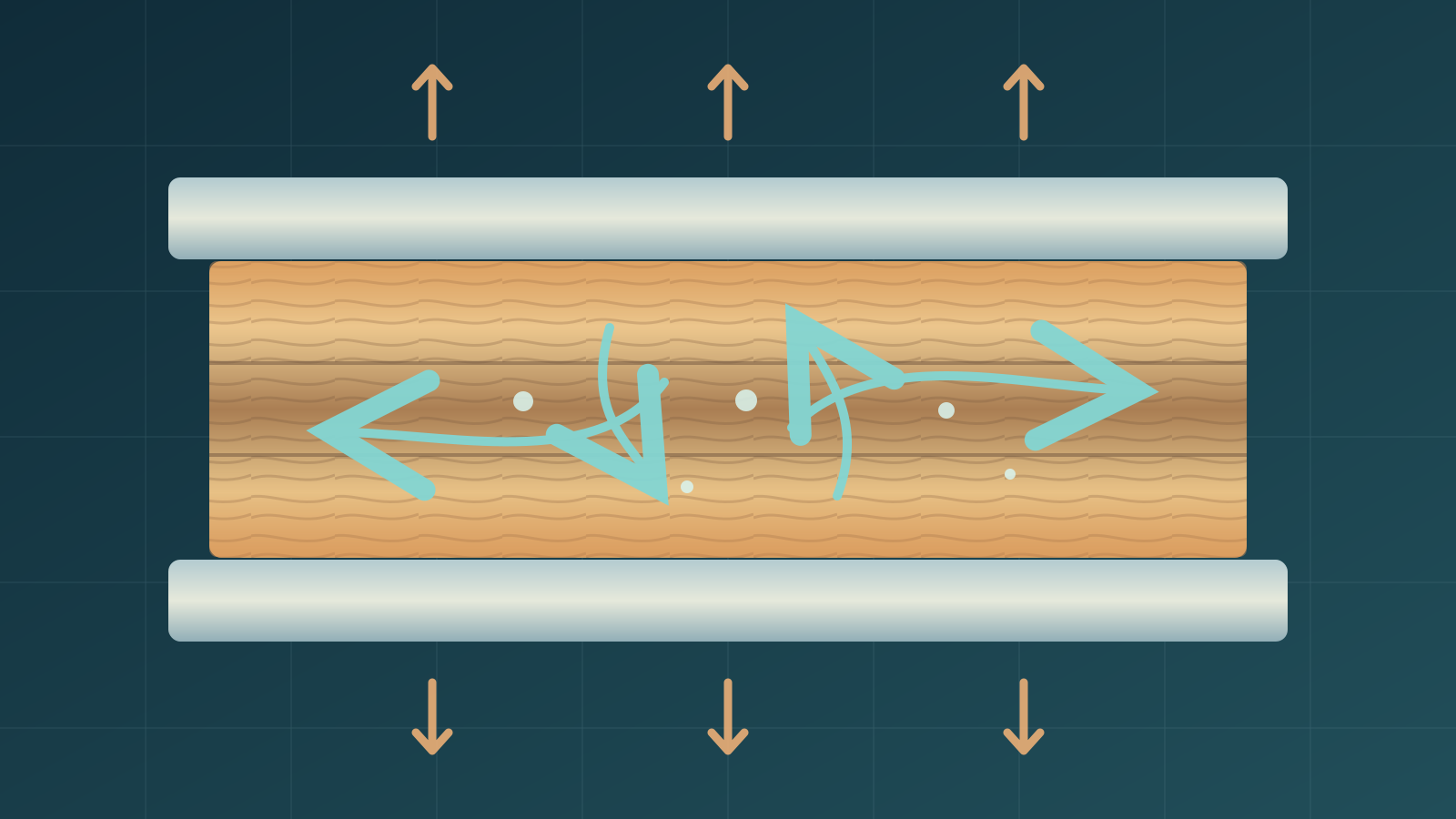
- Rising density can restrict vapor escape just as heating generates more steam.
- The first pilot should connect raw material, measured process history, structure, and final properties.
- Use validated material-state signals before replacing timed steps with state-based control.
Natural materials vary; identify the variation that matters
Wood fibers and other lignocellulosic feedstocks vary in length, morphology, chemistry, moisture, and storage history. The engineering question is which of those variations change the final material, and whether the process can detect them.[1]
In our work on dense wood-fiber networks, shorter aspen fibers achieved tensile properties comparable to longer spruce fibers after densification. Fiber length alone did not predict the outcome; interfiber interactions and the structure created during processing mattered.[1]
A hot press couples compression, heating, and drying
A nominal recipe such as 180 °C, 5 MPa, and 10 minutes is useful for setting the machine. It does not describe the material state. Surfaces near the plates heat first while the core may remain cooler and wetter; moisture also softens wood polymers and helps fibers conform and bond.[3][6]
This creates a tradeoff: water can aid densification early, yet excess water must leave before release. Press schedules, moisture, and density interact. A change that shortens heating may also change pressure buildup, bonding, or drying.[3][6]
Where does moisture go during hot pressing?
At first, water near hot surfaces evaporates. Vapor may travel into cooler regions and condense there; it can evaporate again as the core warms. Moisture also moves toward free edges. A single average moisture value cannot distinguish dry faces from a wet core.[4][3]
Measurements in wood-panel pressing show gradients both through the thickness and from the center toward the edge. For a thicker part, the location of residual moisture may matter more than the average alone.[4][3]
Steam needs an escape path
A fiber mat begins relatively open, but compression reduces pore space and can lower permeability. The process can therefore generate vapor while narrowing its exit routes. Internal pressure depends on moisture, density, thickness, closing speed, fiber orientation, geometry, and venting.[3][4]
Laboratory MDF experiments measured sharply lower gas permeability at higher density. Particleboard experiments found greater internal steam pressure as panel dimensions increased. These are material- and geometry-specific results, not universal pressure limits.[3][4]
Press opening can reveal a hidden defect
A panel can look dry outside while its core still holds vapor pressure. Releasing the mechanical load then lets trapped vapor expand, which can cause blisters or delamination, often called a blow in wood-panel production.[5]
Higher temperature is not automatically a faster safe cycle: it can generate steam more quickly. A denser structure can slow venting, while a shorter cycle can leave more pressure at opening. Release conditions need their own validation.[5]
A setpoint is not evidence of a process history
The recipe says 180 °C, 5 MPa, and 10 minutes. A useful history records plate and core temperature, force, displacement, moisture-related signals, vapor pressure where practical, venting, and the point at which the press opened.[6]
Compare these time histories with final thickness, density, and mechanical tests. If two batches produce different properties, the recorded history can show when they diverged. Without it, troubleshooting largely depends on guesses.[6]
Scale-up changes heat and mass transfer
A small laboratory plate gives vapor a short route to an edge. A larger component can have the same chemistry and nominal setpoints yet a much longer escape path. More material also changes the balance between heat entering, moisture moving, and vapor leaving.[4]
A particleboard study measured substantially higher peak internal steam pressure in larger panels under its test conditions. Do not transfer that numerical result to another material; use it as a reason to test the intended geometry and cycle.[4]
Measure enough to infer the material state
Internal sensors are useful in development but can be difficult to keep in a hot, compressed industrial product. Choose signals that distinguish the process states that matter, then validate them against destructive testing and material properties.[3][6]
| Measurement | What it reveals |
|---|---|
| Initial moisture | Starting condition |
| Plate and core temperature | Applied heating and core response |
| Press force and displacement | Loading, consolidation, and thickness change |
| Internal pressure or exhaust flow | Vapor buildup or escape, when measurable |
| Final mass, thickness, and tests | Drying, density, and quality outcome |
Record the initial condition, thermal boundary, core response, mechanical consolidation, evidence of drying, and final quality. A sensor list is not a control strategy until each signal has a decision attached to it.[3][6]
Move from timer control toward validated state control
Materials science connects processing to structure and properties. Control engineering connects measurements to a state estimate, decision, and action. Both are needed when variable feedstock enters a repeatable process.[2][6]
A validated drying stage might end when measured signals indicate the required state, rather than after a fixed ten minutes. That rule must be established experimentally for each material and geometry; a convenient sensor proxy is not proof that the core is dry.[2][6]
Design the first pilot to learn
The first pilot should reproduce temperature histories, expose effects of incoming moisture, show when water leaves, and relate pressure and displacement traces to mechanical performance. Keep failed runs in the record as well as successful ones.[2]
A sustainable material becomes manufacturable when different batches can repeatedly meet a defined quality target at the intended size and cycle. Knowing the recipe is only the starting point; knowing and controlling the history is the scale-up task.[2]
Frequently asked questions
Why does moisture matter during hot pressing?
It assists heat transfer and fiber deformation, but must eventually escape. Too little or too much can change consolidation, pressure, and quality.
Does water only move from the center toward the surface?
No. Vapor can move from hot surfaces toward a cooler core, condense, re-evaporate, and later reach free edges.
Why can a panel delaminate when the press opens?
Residual vapor pressure may exceed the material’s developing internal bond strength after external pressure is removed.
Does every production press need a sensor inside the material?
No. Internal measurements are valuable in development. Production can use fewer robust signals once they are validated against the material state and final quality.
Sources and standards
- High-density short aspen fiber networks have similar tensile properties as networks from longer spruce fibersMaterials & Design, 2026
- Lignocellulose Biocomposites – A Comparison of Wood Fibers and Microfibrillated LignocelluloseKTH Royal Institute of Technology, 2022
- Characterization of Heat and Mass Transfer in the Mat during the Hot Pressing of MDF PanelsWood and Fiber Science, 2007
- Effects of press sizes on internal steam pressure during particleboard hot-pressing processForest Products Journal / US Forest Service, April 2009
- Effects of panel density and mat moisture content on processing medium density fiberboardForest Products Journal / US Forest Service, October 2006
- Influence of Pressing Schedule and Adhesive Content on the Rheological Behavior of Wood Fiber-Furnish MatsMaterials (Basel), 2022


