Capabilities
Observability
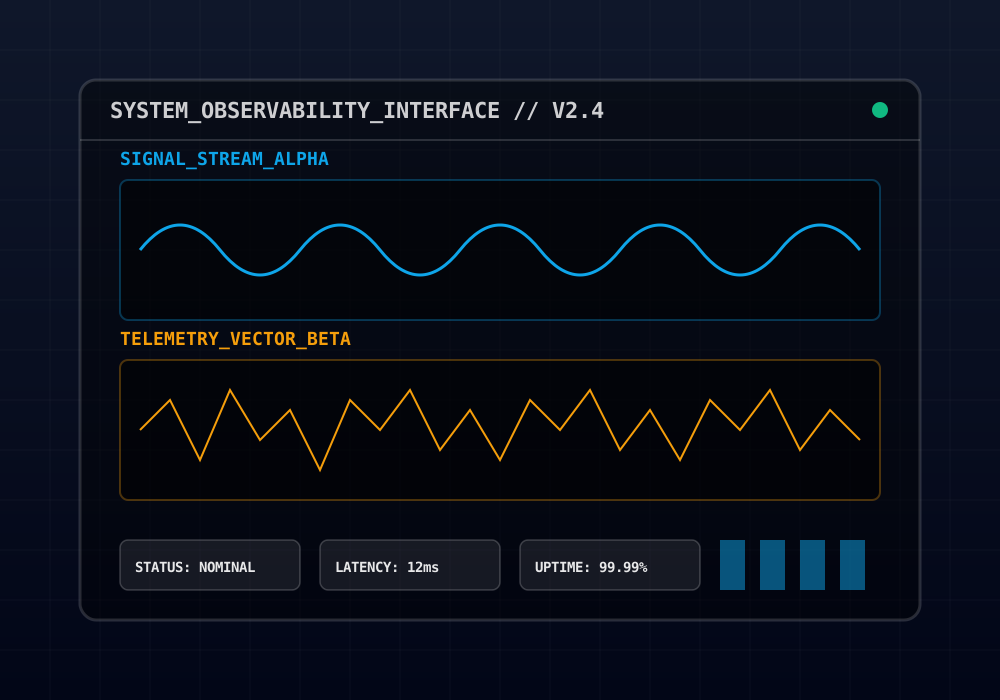
Operational observability for distributed control: state, health, and diagnostics that connect UI, backend, and edge.
Design intent
Use this lens when adopting Observability: define success criteria, start narrow, and scale with safe rollouts and observability.
- Unified timelines reduce time-to-diagnosis across teams
- Stable IDs + rollout state make incidents debuggable
- Alerts should detect degradation, not just total failure
What it is
A distributed automation system needs end-to-end visibility: runtime health, fleet status, and telemetry tied back to versions and deployments.
Design constraints
- Unified timelines reduce time-to-diagnosis across teams
- Stable IDs + rollout state make incidents debuggable
- Alerts should detect degradation, not just total failure
Architecture at a glance
- Edge emits health/events/telemetry with stable IDs (device/resource/app/deploy)
- Store-and-forward buffers protect evidence during outages
- Backend correlates timelines to snapshots so debugging becomes “find the diff”
- This is a capability surface concern: visibility is required to scale safely
Typical workflow
- Define the minimal signal set: deployment state + runtime health + adapter health + telemetry
- Create dashboards that answer: what is running? is it healthy? is it correct?
- Use correlated timelines (events + telemetry + rollout state) to debug
- Codify alerts for restart bursts, buffer saturation, flapping, and drift
System boundary
Treat Observability as a capability boundary: define what success means, what is configurable per site, and how you will validate behavior under rollout.
Example artifact
Event timeline (conceptual)
t=00:00 deploy:start snapshot=snap_... device=edge-12
t=00:12 runtime:healthy resource=forte-1
t=00:20 adapter:connected protocol=modbus endpoint=pump-1
t=01:10 telemetry:ok points=128 gap=0s
t=03:40 alert:staleness point=pump_speed > 5s
What it enables
- Faster incident response with clear traces
- Rollout safety gates based on health
- Confidence when changing logic and configuration
Engineering outcomes
- Unified timelines reduce time-to-diagnosis across teams
- Stable IDs + rollout state make incidents debuggable
- Alerts should detect degradation, not just total failure
Quick acceptance checks
- Define standard health signals for runtime, adapters, and deployments
- Ensure timelines can join telemetry + events + deployments via stable IDs
Common failure modes
- Telemetry gaps from buffer saturation or upstream auth/network issues
- Clock skew and batching causing out-of-order timelines
- “Everything is green” while behavior is wrong (mapping/data-quality issue)
- Over-alerting: noisy signals that hide real regressions
Acceptance tests
- Verify the deployed snapshot/version matches intent (no drift)
- Run a canary validation: behavior, health, and telemetry align with expectations
- Verify rollback works and restores known-good behavior
Deep dive
Practical next steps
How teams typically turn this capability into outcomes.
Key takeaways
- Unified timelines reduce time-to-diagnosis across teams
- Stable IDs + rollout state make incidents debuggable
- Alerts should detect degradation, not just total failure
Checklist
- Define standard health signals for runtime, adapters, and deployments
- Ensure timelines can join telemetry + events + deployments via stable IDs
- Create incident views: “what changed?”, “what failed first?”, “what recovered?”
- Alert on restart bursts, drift, buffer saturation, and connectivity flaps
Next steps
Related topics
Deep dive
Common questions
Quick answers that help align engineering and operations.
What’s the minimum observability needed to operate remotely?
Deployment status + runtime health + connectivity/adapter health + basic telemetry timelines tied to snapshot IDs.
Why do incidents feel hard without good observability?
Because you can’t correlate symptoms to changes. Version-correlation is what turns “mystery behavior” into a solvable diff.
How do we reduce time-to-diagnosis?
Use consistent IDs, record state transitions, and keep a single timeline view that joins deployments, health, and telemetry.