Platform

ENGINEERING OVERVIEW.

BootCtrl is centered around Eclipse 4diac FORTE (IEC 61499) running on edge devices, managed by a central backend and configured via a web UI.
Bootctrl architecture overview

UI

DESIGN STUDIO

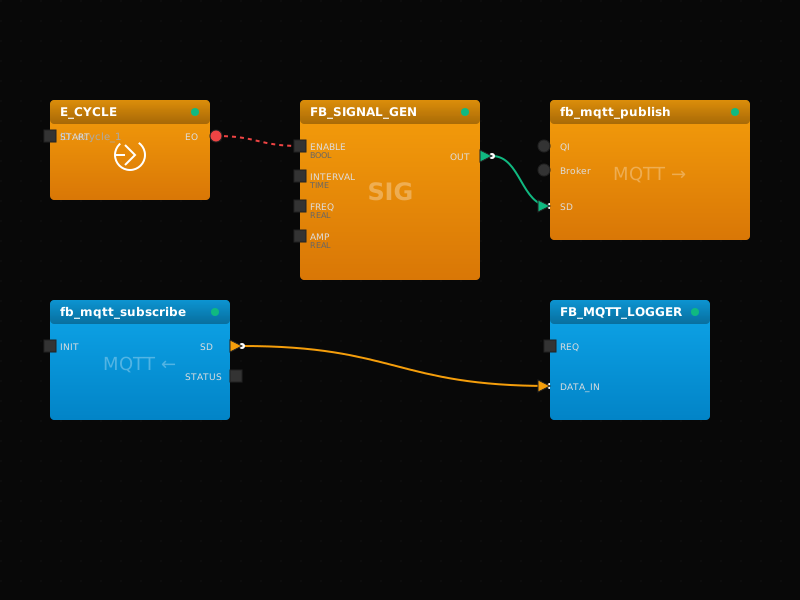
A web interface for configuring systems/devices, building IEC 61499 control logic, mapping I/O, and monitoring runtime state.

Control design

  • Build FB networks (applications) and device configurations
  • Map I/O points (e.g., Modbus registers, OPC UA nodes) into the program
  • Export designs for deployment artifacts and configuration generation
Deep dive

Canvas versioning

  • Save/load versioned snapshots through backend versioning endpoints
  • Store metadata in Postgres and assets/thumbnails in S3-compatible storage (MinIO in dev)
  • Rehydrate the UI state from any snapshot for traceability and rollback
Deep dive

I/O mapping

  • Define I/O points once and reuse them across applications
  • Bind protocol addresses and scaling to stable identifiers
  • Validate mappings before deployment to reduce field surprises
Deep dive

Live observability

  • Inspect device health, runtime state, and deployment status
  • View variable snapshots and recent events in context
  • Correlate design versions with what is running in the field
Deep dive

The Engine

EDGE AGENT

A Rust daemon that runs near machines, supervises the runtime, bridges industrial protocols, and forwards telemetry.

Execution

  • Supervises the local control runtime via a runtime adapter (UDS gRPC preferred)
  • Exposes a local API for health/status and variable operations
  • Designed to run on real devices or in lab/testbed environments
Deep dive

Operations

  • OTA updates plus restart/rollback supervision mechanisms
  • Optional Bearer-token RBAC and rate limiting for the local API
  • Protocol connectors (e.g., Modbus) and MQTT telemetry publishing
Deep dive

Connectivity

  • Bridges industrial protocols at the edge (e.g., Modbus, OPC UA)
  • Normalizes data into stable tags/points for the control program
  • Supports offline-first operation with safe reconnection behavior
Deep dive

Telemetry + events

  • Publishes metrics, events, and logs upstream (often via MQTT)
  • Adds device identity and version metadata for traceability
  • Optimized for low bandwidth with batching and backpressure
Deep dive

The Runtime

CONTROL RUNTIME

Eclipse 4diac FORTE packaged with a runtime adapter layer for control and variable access.

IEC 61499

  • Event-driven execution model
  • Explicit interfaces and composable function blocks
  • Systems/devices/resources as core domain concepts
Deep dive

Runtime adapter

  • A consistent API surface between FORTE and the edge-agent
  • Supports local control operations (start/stop, deploy, query variables)
  • Delivered as part of the runtime image via infrastructure Docker builds
Deep dive

Deterministic loops

  • Prioritizes predictable execution paths for critical logic
  • Separates control from supervision/telemetry concerns
  • Designed for repeatable behavior across devices
Deep dive

Safety surfaces

  • Explicit start/stop/deploy operations through the adapter
  • Health checks and guarded transitions for runtime state
  • Rollback-friendly deployments paired with versioned artifacts
Deep dive

The Brain

ORBITAL BACKEND

A Spring Boot backend with REST + WebSocket APIs, orchestration, versioning, and multi-store persistence.

Orchestration

  • REST API at /api/v1 plus WebSocket endpoints for live updates
  • Canvas versioning: metadata in Postgres, blobs in S3-compatible storage
  • Persists configurations, deployments, and system topology
Deep dive

Telemetry

  • Ingests telemetry (often via MQTT) and stores time-series/analytics data
  • Backed by Postgres/Timescale + optional InfluxDB and/or ClickHouse
  • Streams updates to the UI over WebSocket for monitoring and correlation
Deep dive

Versioning

  • Stores immutable snapshots of designs and deployment artifacts
  • Enables rollback and reproducibility across environments
  • Maintains audit-friendly metadata tied to devices and missions
Deep dive

Security

  • Token-based auth and role-aware API access patterns
  • Separates control-plane operations from data-plane telemetry
  • Designed for multi-tenant deployments and least-privilege access
Deep dive

Data Flows

END-TO-END BEHAVIOR.

How designs become deployments, how runtimes are supervised, and how telemetry returns to operators.

Design → persist → artifacts

  • Engineers build control logic and device configs in the UI
  • Backend persists configurations and assigns stable identifiers
  • Artifacts and payloads are generated for edge deployment

Versioning and traceability

  • Snapshots/assets/thumbnails are stored via versioning endpoints
  • Object storage holds large blobs; Postgres holds metadata
  • UI can restore any snapshot to reproduce incidents and roll back

Runtime supervision and I/O

  • Edge-agent talks locally to the runtime adapter (UDS gRPC preferred)
  • Adapter controls FORTE: deploy programs, query variables, health
  • Industrial protocols are bridged at the edge (e.g., Modbus/OPC UA)

Telemetry and monitoring

  • Edge-agent publishes telemetry/events upstream (often via MQTT)
  • Backend ingests and stores it (InfluxDB/ClickHouse depending on deployment)
  • UI receives live updates over WebSocket for dashboards and diagnostics

Core Concepts

DOMAIN MODEL.

The objects you configure in the UI and persist in the backend when working with IEC 61499/FORTE systems.

System / Device

A physical or virtual controller target (industrial PC, Raspberry Pi, edge computer).

Resource

A FORTE execution container on a device (often a named MainResource).

Function Block (FB)

A reusable control component with event/data inputs and outputs.

FB Network / Application

A connected graph of FB instances and connections—the deployed control program.

I/O Point

A physical signal mapped into/out of the control program (e.g., Modbus register, OPC UA node).

Version / Snapshot

A point-in-time saved design (canvas state + assets) stored and retrievable for traceability and rollback.

Infrastructure

STORAGE + TRANSPORT.

A pragmatic stack for configuration data, snapshots, and telemetry—from local dev to deployments.

Datastores

  • PostgreSQL/Timescale for configuration and relational metadata
  • Redis for caching and fast access patterns
  • InfluxDB and/or ClickHouse for time-series and high-volume analytics (deployment dependent)
Deep dive

Telemetry transport

  • MQTT is a common upstream transport (Mosquitto in local stacks)
  • Backend ingests and correlates telemetry with config and deployment changes
  • UI receives live updates via WebSocket
Deep dive

Object storage

  • S3-compatible storage for snapshots/assets/thumbnails
  • MinIO used in local development stacks
  • Keeps large blobs out of the relational database
Deep dive

Local stacks

  • Docker Compose runs backend + runtime + dependencies
  • UI can run outside Docker and proxy /api and /ws
  • Edge-agent is typically run separately for end-to-end testing
Deep dive

Ready to modernize your control stack?

Join the engineers building the future of industrial automation.