Platform
Telemetry + events
How telemetry is produced at the edge, buffered reliably, and forwarded to the cloud for operations and analytics.
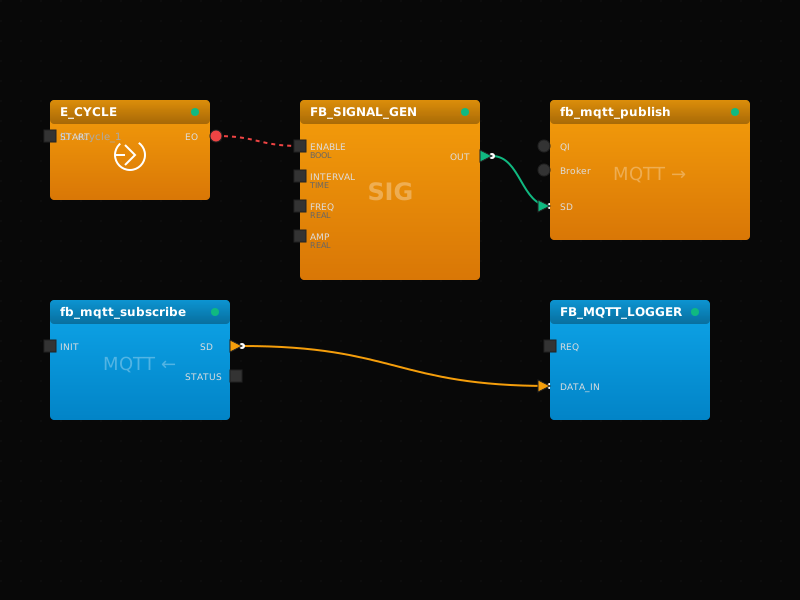
Design intent
Use this lens when implementing Telemetry + events across a fleet: define clear boundaries, make change snapshot-based, and keep operational signals observable.
- Buffering + batching makes telemetry resilient to WAN instability
- Volume control (sampling/exceptions) keeps cost and UX predictable
- Version-correlation makes regressions attributable and reversible
What it is
Edge telemetry includes state changes, health events, measurements, and traces collected near machines and forwarded upstream with buffering when links are unreliable.
What gets sent
- Runtime health and lifecycle events (start/stop/restart/degraded)
- Operational metrics (buffer depth, upload latency, error counters)
- Selected point/value telemetry (sampled or report-by-exception)
- Deployment correlation (which snapshot/version is producing the data)
Delivery model
- Local buffering (store-and-forward) to survive link outages
- Batching and compression (conceptually) to reduce bandwidth overhead
- Backpressure-aware upload so edge execution remains stable under load
Design constraints
- Buffering + batching makes telemetry resilient to WAN instability
- Volume control (sampling/exceptions) keeps cost and UX predictable
- Version-correlation makes regressions attributable and reversible
Architecture at a glance
- Edge emits health/events/telemetry with stable IDs (device/resource/app/deploy)
- Store-and-forward buffers protect evidence during outages
- Backend correlates timelines to snapshots so debugging becomes “find the diff”
- This is a UI + backend + edge concern: visibility is required to scale safely
Typical workflow
- Define the minimal signal set: deployment state + runtime health + adapter health + telemetry
- Create dashboards that answer: what is running? is it healthy? is it correct?
- Use correlated timelines (events + telemetry + rollout state) to debug
- Codify alerts for restart bursts, buffer saturation, flapping, and drift
System boundary
Treat Telemetry + events as a repeatable interface between engineering intent (design) and runtime reality (deployments + signals). Keep site-specific details configurable so the same design scales across sites.
How it relates to snapshots
Because it lets you answer whether a symptom started with a specific release and rollback deterministically if needed.
Example artifact
Event timeline (conceptual)
t=00:00 deploy:start snapshot=snap_... device=edge-12
t=00:12 runtime:healthy resource=forte-1
t=00:20 adapter:connected protocol=modbus endpoint=pump-1
t=01:10 telemetry:ok points=128 gap=0s
t=03:40 alert:staleness point=pump_speed > 5s
Why it matters
- Prevents data loss during network disruptions
- Enables incident debugging with real timelines
- Supports rollout safety gates and anomaly detection
Engineering outcomes
- Buffering + batching makes telemetry resilient to WAN instability
- Volume control (sampling/exceptions) keeps cost and UX predictable
- Version-correlation makes regressions attributable and reversible
Quick acceptance checks
- Confirm buffer sizing matches worst-case outage durations
- Set sampling/report-by-exception to control volume and cardinality
What to monitor
Buffer saturation, upstream auth/network failures, or mis-sized batching. Monitor buffer depth, drops, and upload retry counts.
Common failure modes
- Telemetry gaps from buffer saturation or upstream auth/network issues
- Clock skew and batching causing out-of-order timelines
- “Everything is green” while behavior is wrong (mapping/data-quality issue)
- Over-alerting: noisy signals that hide real regressions
Acceptance tests
- Verify the deployed snapshot/version matches intent (no drift)
- Run a canary validation: behavior, health, and telemetry align with expectations
- Verify rollback works and restores known-good behavior
In the platform
- Store-and-forward pipelines
- Report-by-exception and sampling controls
- Health + telemetry correlation to deployments
Failure modes
- Buffer saturation when offline too long or telemetry volume is too high
- Clock skew that makes timelines look “out of order” across sites
- Authentication/authorization failures to upstream endpoints
- High-cardinality telemetry that becomes expensive to store/query
What to monitor
- Upload success rates and retry counts
- Edge buffer depth and “time behind” (how stale uploaded data is)
- Drop counters (if configured) and sampling/report-by-exception settings
- End-to-end latency from edge emit → cloud ingest → UI visible
Implementation checklist
- Confirm buffer sizing matches worst-case outage durations
- Set sampling/report-by-exception to control volume and cardinality
- Validate auth/permissions for uplink endpoints
- Track “time behind” and end-to-end latency edge → cloud → UI
Rollout guidance
- Start with a canary site that matches real conditions
- Use health + telemetry gates; stop expansion on regressions
- Keep rollback to a known-good snapshot fast and rehearsed
Acceptance tests
- Verify the deployed snapshot/version matches intent (no drift)
- Run a canary validation: behavior, health, and telemetry align with expectations
- Verify rollback works and restores known-good behavior
Deep dive
Practical next steps
How teams typically apply this in real deployments.
Key takeaways
- Buffering + batching makes telemetry resilient to WAN instability
- Volume control (sampling/exceptions) keeps cost and UX predictable
- Version-correlation makes regressions attributable and reversible
Checklist
- Confirm buffer sizing matches worst-case outage durations
- Set sampling/report-by-exception to control volume and cardinality
- Validate auth/permissions for uplink endpoints
- Track “time behind” and end-to-end latency edge → cloud → UI
Next steps
Related topics
Deep dive
Common questions
Quick answers that help during commissioning and operations.
What causes telemetry gaps?
Buffer saturation, upstream auth/network failures, or mis-sized batching. Monitor buffer depth, drops, and upload retry counts.
How do we keep telemetry affordable?
Avoid high-cardinality signals, use report-by-exception, batch uploads, and keep consistent identifiers so queries can join cleanly.
Why is correlation to snapshots important?
Because it lets you answer whether a symptom started with a specific release and rollback deterministically if needed.