Platform
Telemetry transport
How messaging and eventing connect services for orchestration, telemetry ingestion, and operational workflows.
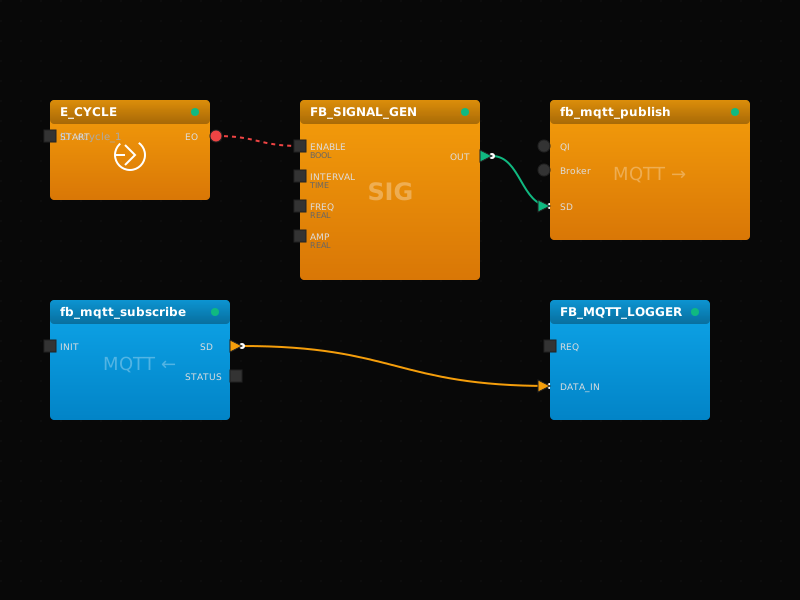
Design intent
Use this lens when implementing Telemetry transport across a fleet: define clear boundaries, make change snapshot-based, and keep operational signals observable.
- Idempotency is the foundation for safe retries
- Dead-letter handling prevents silent workflow loss
- Ordering must be explicit; assume out-of-order delivery
What it is
Messaging provides asynchronous, decoupled communication between services (and sometimes edge) for events, jobs, and stream processing.
Where it helps (examples)
- Deployments: queue rollout steps and capture state transitions reliably
- Telemetry: buffer ingestion, processing, enrichment, and indexing
- Notifications: emit events for alerts and operational workflows
Design constraints
- Idempotency is the foundation for safe retries
- Dead-letter handling prevents silent workflow loss
- Ordering must be explicit; assume out-of-order delivery
Architecture at a glance
- Define a stable artifact boundary (what you deploy) and a stable signal boundary (what you observe)
- Treat changes as versioned, testable, rollbackable units
- Use health + telemetry gates to scale safely
Typical workflow
- Define scope and success criteria (what should change, what must stay stable)
- Create or update a snapshot, then validate against a canary environment/site
- Deploy progressively with health/telemetry gates and explicit rollback criteria
- Confirm acceptance tests and operational dashboards before expanding
System boundary
Treat Telemetry transport as a repeatable interface between engineering intent (design) and runtime reality (deployments + signals). Keep site-specific details configurable so the same design scales across sites.
Example artifact
Implementation notes (conceptual)
topic: Telemetry transport
plan: define -> snapshot -> canary -> expand
signals: health + telemetry + events tied to version
rollback: select known-good snapshot
Why it matters
- Improves resilience under spikes and partial outages
- Enables scalable telemetry ingestion and processing
- Supports orchestration workflows without tight coupling
Engineering outcomes
- Idempotency is the foundation for safe retries
- Dead-letter handling prevents silent workflow loss
- Ordering must be explicit; assume out-of-order delivery
Quick acceptance checks
- Make workflows idempotent so retries are safe
- Define dead-letter/poison message handling and alerting
Common failure modes
- Drift between desired and actual running configuration
- Changes without clear rollback criteria
- Insufficient monitoring for acceptance after rollout
Acceptance tests
- Verify the deployed snapshot/version matches intent (no drift)
- Run a canary validation: behavior, health, and telemetry align with expectations
- Verify rollback works and restores known-good behavior
In the platform
- Orchestration job queues and status updates
- Telemetry ingestion pipelines
- Event-driven automation and notifications
Failure modes
- Poison messages that repeatedly fail processing
- Out-of-order handling when ordering isn’t guaranteed
- Backlogs that grow without backpressure or scaling policies
Implementation checklist
- Make workflows idempotent so retries are safe
- Define dead-letter/poison message handling and alerting
- Use backpressure and scaling policies to avoid runaway backlogs
- Encode ordering assumptions explicitly (don’t rely on luck)
Operational notes
Use correlation IDs, record state transitions, and surface per-step outcomes so a single failed step is visible.
Rollout guidance
- Start with a canary site that matches real conditions
- Use health + telemetry gates; stop expansion on regressions
- Keep rollback to a known-good snapshot fast and rehearsed
Acceptance tests
- Verify the deployed snapshot/version matches intent (no drift)
- Run a canary validation: behavior, health, and telemetry align with expectations
- Verify rollback works and restores known-good behavior
Deep dive
Practical next steps
How teams typically apply this in real deployments.
Key takeaways
- Idempotency is the foundation for safe retries
- Dead-letter handling prevents silent workflow loss
- Ordering must be explicit; assume out-of-order delivery
Checklist
- Make workflows idempotent so retries are safe
- Define dead-letter/poison message handling and alerting
- Use backpressure and scaling policies to avoid runaway backlogs
- Encode ordering assumptions explicitly (don’t rely on luck)
Next steps
Related topics
Deep dive
Common questions
Quick answers that help during commissioning and operations.
Where should we use messaging vs direct calls?
Use messaging for workflows that must survive partial outages (deploy orchestration, telemetry pipelines, notifications). Use direct calls for low-latency request/response interactions.
What are the top three messaging failure modes?
Poison messages, unbounded backlog growth, and ordering assumptions that aren’t enforced. Plan for all three up front.
How do we debug workflows that span services?
Use correlation IDs, record state transitions, and surface per-step outcomes so a single failed step is visible.