Platform
Runtime adapter
How the runtime interfaces with external systems and field I/O through adapters, while keeping control logic portable and testable.
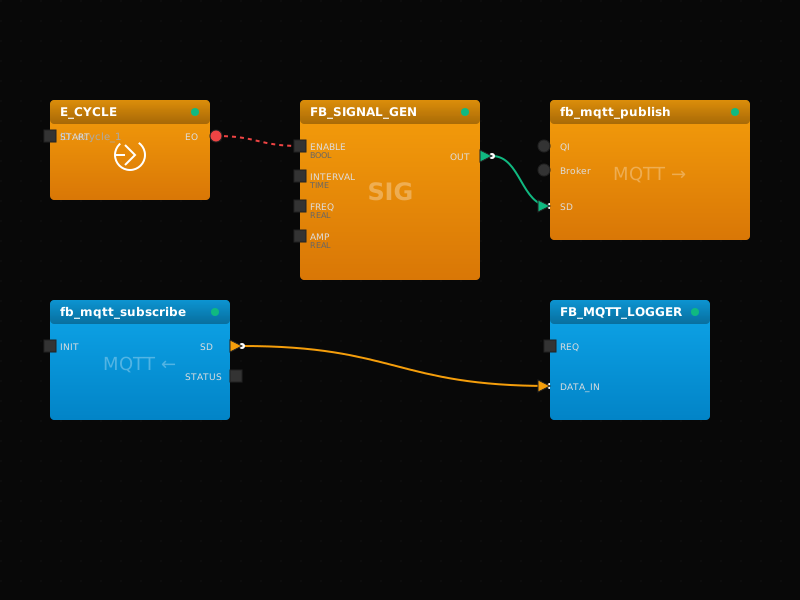
Design intent
Use this lens when implementing Runtime adapter across a fleet: define clear boundaries, make change snapshot-based, and keep operational signals observable.
- Adapters keep protocols and variability out of timing-critical logic
- Explicit degradation beats implicit partial failure
- Adapter health must be observable like runtime health
What it is
Bridging is the adapter boundary between standard IEC 61499 execution and the site-specific world of protocols, devices, and operational integrations.
How it works (high level)
- Control logic operates on a stable model of inputs/outputs (points/signals)
- Adapters translate that model into protocol reads/writes and external calls
- Health and errors are exposed as first-class operational signals
Design constraints
- Adapters keep protocols and variability out of timing-critical logic
- Explicit degradation beats implicit partial failure
- Adapter health must be observable like runtime health
Architecture at a glance
- Define a stable artifact boundary (what you deploy) and a stable signal boundary (what you observe)
- Treat changes as versioned, testable, rollbackable units
- Use health + telemetry gates to scale safely
Typical workflow
- Define scope and success criteria (what should change, what must stay stable)
- Create or update a snapshot, then validate against a canary environment/site
- Deploy progressively with health/telemetry gates and explicit rollback criteria
- Confirm acceptance tests and operational dashboards before expanding
System boundary
Treat Runtime adapter as a repeatable interface between engineering intent (design) and runtime reality (deployments + signals). Keep site-specific details configurable so the same design scales across sites.
Example artifact
Implementation notes (conceptual)
topic: Runtime adapter
plan: define -> snapshot -> canary -> expand
signals: health + telemetry + events tied to version
rollback: select known-good snapshot
Why it matters
- Separates control logic from device/protocol churn
- Enables repeatable deployments across heterogeneous hardware
- Simplifies troubleshooting by making boundaries explicit
Engineering outcomes
- Adapters keep protocols and variability out of timing-critical logic
- Explicit degradation beats implicit partial failure
- Adapter health must be observable like runtime health
Quick acceptance checks
- Keep protocol/IO calls out of hot control paths (avoid blocking)
- Define explicit error handling and degradation modes per adapter
Common failure modes
- Drift between desired and actual running configuration
- Changes without clear rollback criteria
- Insufficient monitoring for acceptance after rollout
Acceptance tests
- Verify the deployed snapshot/version matches intent (no drift)
- Run a canary validation: behavior, health, and telemetry align with expectations
- Verify rollback works and restores known-good behavior
In the platform
- Runtime adapter APIs for I/O and services
- Protocol-layer integration via edge agents/adapters
- Stable abstractions for points and signals
Design constraints
- Bounded latency and predictable timing (avoid blocking the control loop)
- Clear ownership of writes (prevent competing controllers)
- Graceful degradation when some integrations fail
Common failure modes
- Blocking I/O in the wrong place causing timing jitter
- Ambiguous mapping (wrong units/scaling) leading to “correct looking” but wrong behavior
- Integration failures that cascade instead of isolating cleanly
Implementation checklist
- Keep protocol/IO calls out of hot control paths (avoid blocking)
- Define explicit error handling and degradation modes per adapter
- Validate mapping contracts (types/units) between adapters and logic
- Expose adapter health as first-class operational signals
Rollout guidance
- Start with a canary site that matches real conditions
- Use health + telemetry gates; stop expansion on regressions
- Keep rollback to a known-good snapshot fast and rehearsed
Acceptance tests
- Verify the deployed snapshot/version matches intent (no drift)
- Run a canary validation: behavior, health, and telemetry align with expectations
- Verify rollback works and restores known-good behavior
Deep dive
Practical next steps
How teams typically apply this in real deployments.
Key takeaways
- Adapters keep protocols and variability out of timing-critical logic
- Explicit degradation beats implicit partial failure
- Adapter health must be observable like runtime health
Checklist
- Keep protocol/IO calls out of hot control paths (avoid blocking)
- Define explicit error handling and degradation modes per adapter
- Validate mapping contracts (types/units) between adapters and logic
- Expose adapter health as first-class operational signals
Next steps
Related topics
Deep dive
Common questions
Quick answers that help during commissioning and operations.
Where should integration logic live?
In adapters at the boundary, not in the control network. That keeps control portable and makes failures isolatable.
How do we handle partial failures?
Fail closed or degrade explicitly per adapter. Keep the core runtime stable and surface clear health/errors for the failing integration.
What’s the biggest adapter anti-pattern?
Doing variable-latency work inside timing-critical loops. Always isolate slow or flaky work behind buffering and retries.