 v0.7
MOTION-CONTROLLER-12
Coordinate the machine
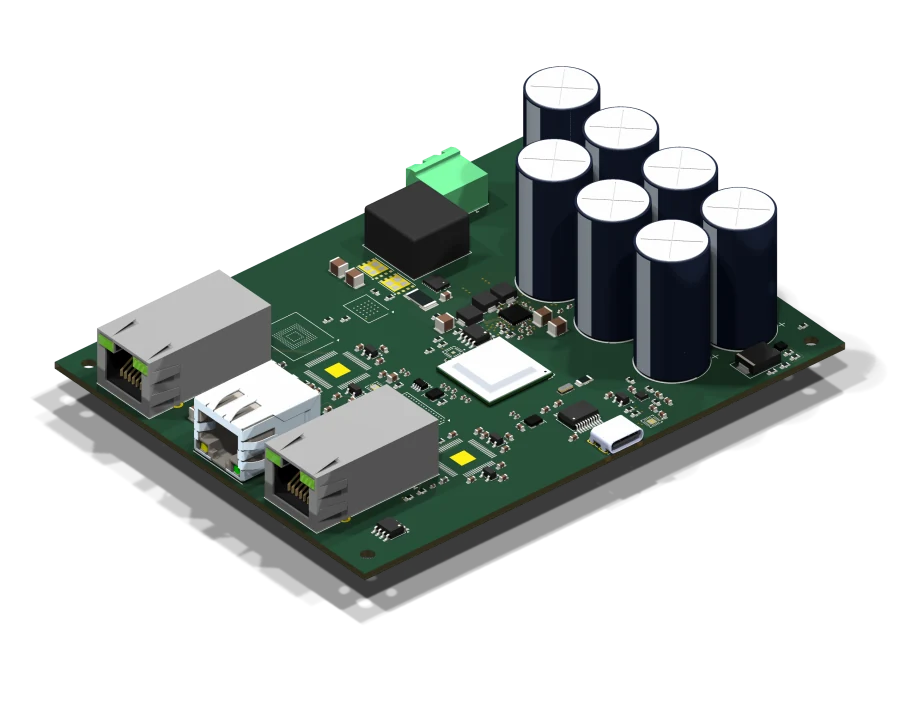
An AM6442-based controller architecture for 2–12 axes over a private EtherCAT network.
Technical propertiesFor builders of compact packaging, labelling and dispensing equipment. Evaluate coordinated feeding, positioning and dosing with a four- or six-axis starting configuration. An axis is one controlled movement.
Each identical drive module controls two motors locally. Add slices to match your machine’s movements.
A private EtherCAT network is designed to coordinate movement while each drive runs its local motor loops.
The required power-management board coordinates precharge, protected branches and regenerative energy with an external power assembly.
Functional illustration · not a physical board layout
An AM6442-based controller architecture for 2–12 axes over a private EtherCAT network.
A private EtherCAT network is designed to coordinate movement while each drive runs its local motor loops.
One dual-axis drive per two motors. Nominal 48 V operation; operating limits require qualification.
Required control and sensing PCBA for source admission, precharge and braking coordination. External power components are needed.
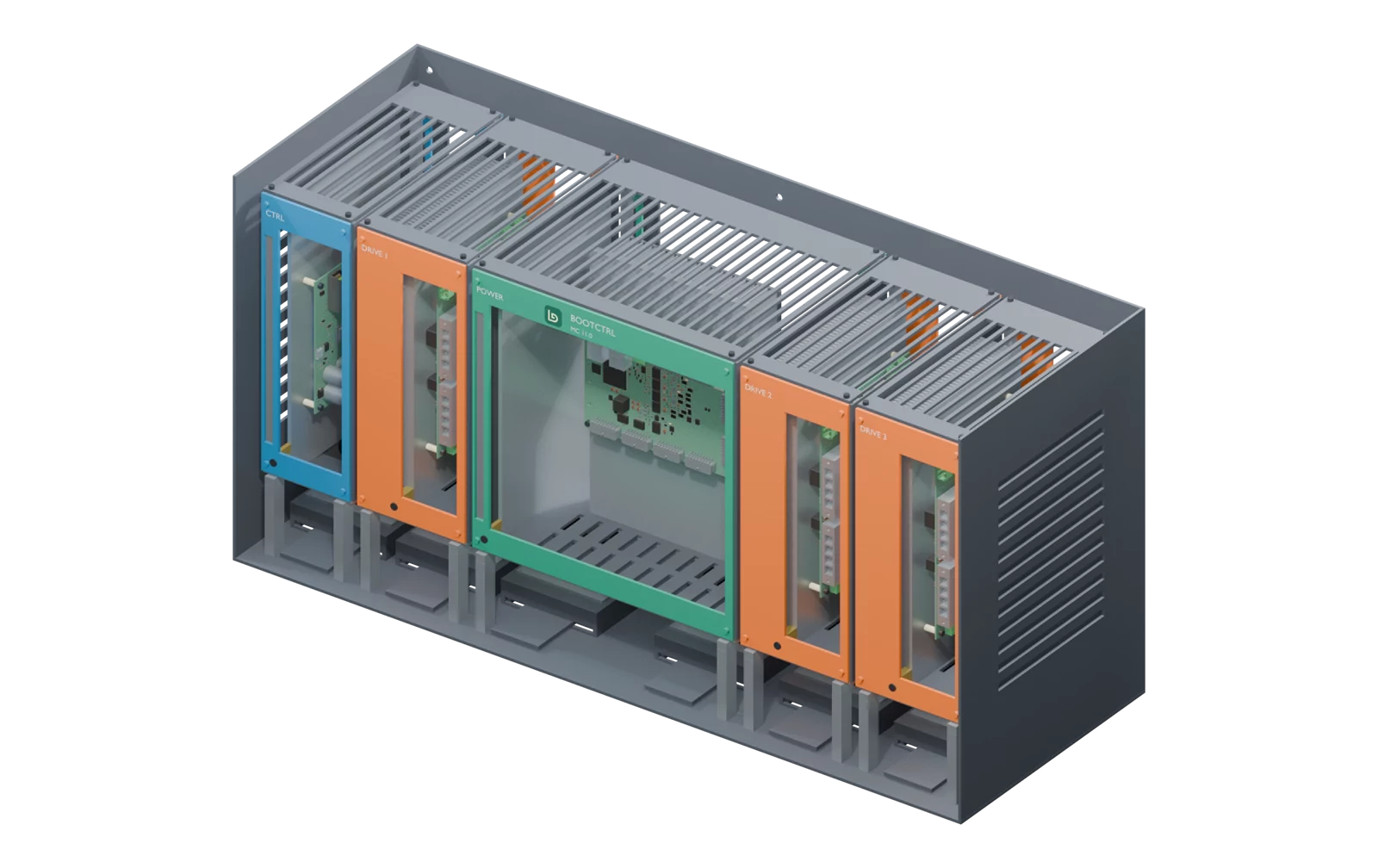
The MC-H01-A study arranges the controller, drive modules and power-distribution board in a shared enclosure. This v0.7 design is for fit and cooling studies; power hardware and thermal interfaces are still being developed.
Housing design prototype · MC-H01-A / v0.7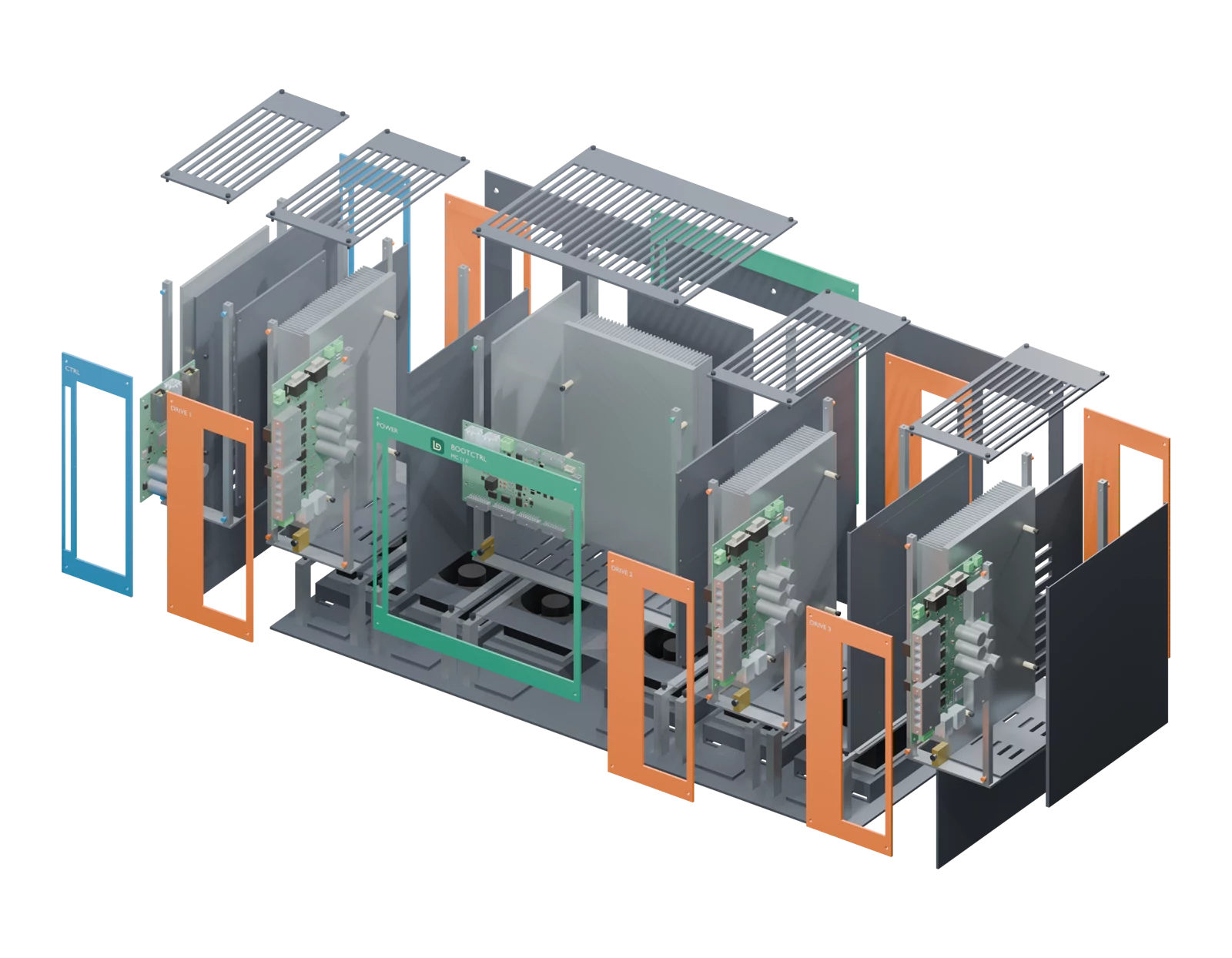
A modular controller, dual-motor drives and power management for compact multi-axis machines.
v0.7An AM6442-based controller architecture for 2–12 axes over a private EtherCAT network.
Technical properties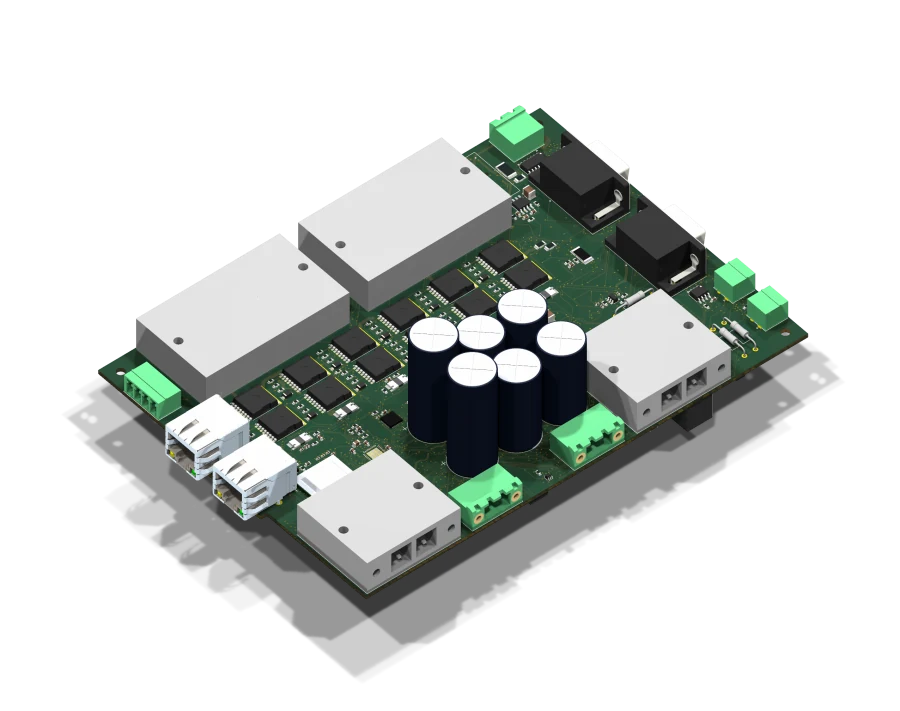 v0.7
One dual-axis drive per two motors. Nominal 48 V operation; operating limits require qualification.
Technical properties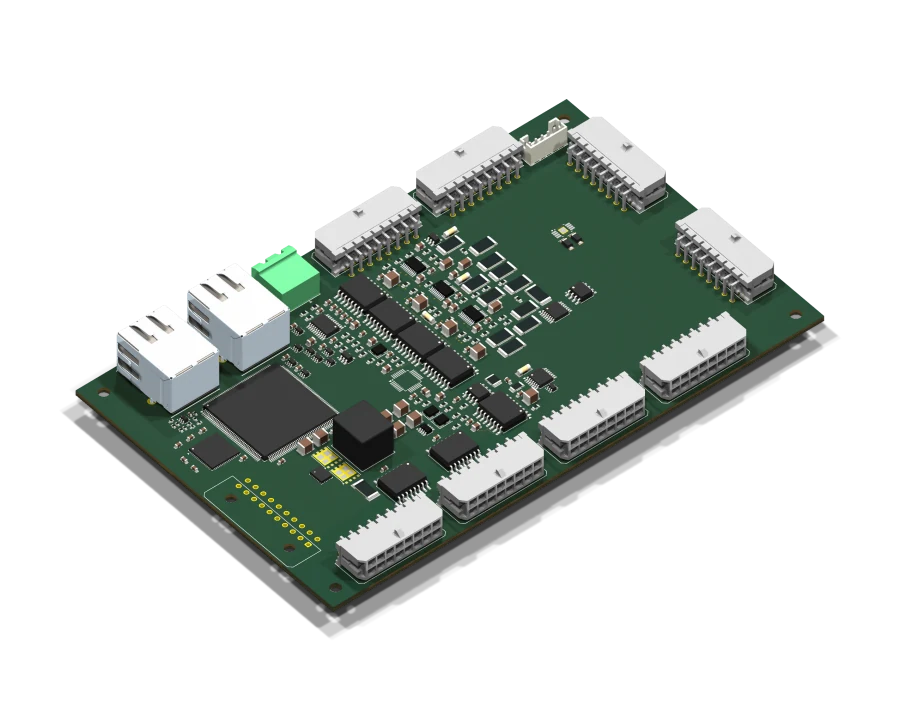 v0.7
Required control and sensing PCBA for source admission, precharge and braking coordination. External power components are needed.
Technical propertiesOptional machine I/O design: 16 protected 24 V inputs and 16 outputs. General machine signals belong here; motor feedback stays at the drive. Local timeout behavior and interface qualification remain release requirements.
Technical propertiesOptional eight-channel industrial process-acquisition design. Select the electrical signal types and timing for the application before integration. This is separate from the industrial controller’s AQ family; interchangeability and qualified performance are not established.
Technical propertiesPreserved earlier design render · not the current hardware revision · Some motion component models are unavailable in the source design.
This family is in engineering development, with routing and qualification still outstanding. Voltage, power, current and timing figures are design targets, not released ratings or a guaranteed simultaneous operating envelope.
We are working toward repeatable commissioning and time-aligned records that help an engineer investigate a stop. Shared-power and braking-energy studies are also part of the development direction. Setup tools, diagnostics and any AI models need their own implementation and machine tests.
A guarded four- or six-axis feeding, positioning or dispensing fixture is a useful evaluation scope. Large paper-machine drives and heat-pump compressor inverters are outside this offer.
No. Independent machine safety, protection, installation and application qualification must be designed and validated for the complete machine.
Compatibility is not established. Review motor feedback, interfaces, timing, current, thermal limits and toolchain requirements before considering a comparative trial.
Bring a machine sequence, a movement challenge, a structural test or an equipment-service question. Let’s define a useful first evaluation.